Alongside the maturity assessments there are eight tools for ongoing delivery work: evidence skills, secure handovers and go-lives, make decisions traceable, renew contracts on time, find root causes, run recurring meetings and plan deputies. All eight are included in the Professional plan and share the same basics.
Shared basics
- Sample data — One click fills the empty tool with a worked example; it then saves automatically.
- PDF export — One or more reports per tool in the common report design (e.g. one-pager, minutes, portfolio).
- Share link and project report — When linked to a project, the tool’s key figures appear in the share link and the project report – without individual records or personal names.
- Read-only — With a cancelled subscription and for team viewers, data remains visible but cannot be changed.
Evidence-based skill matrix
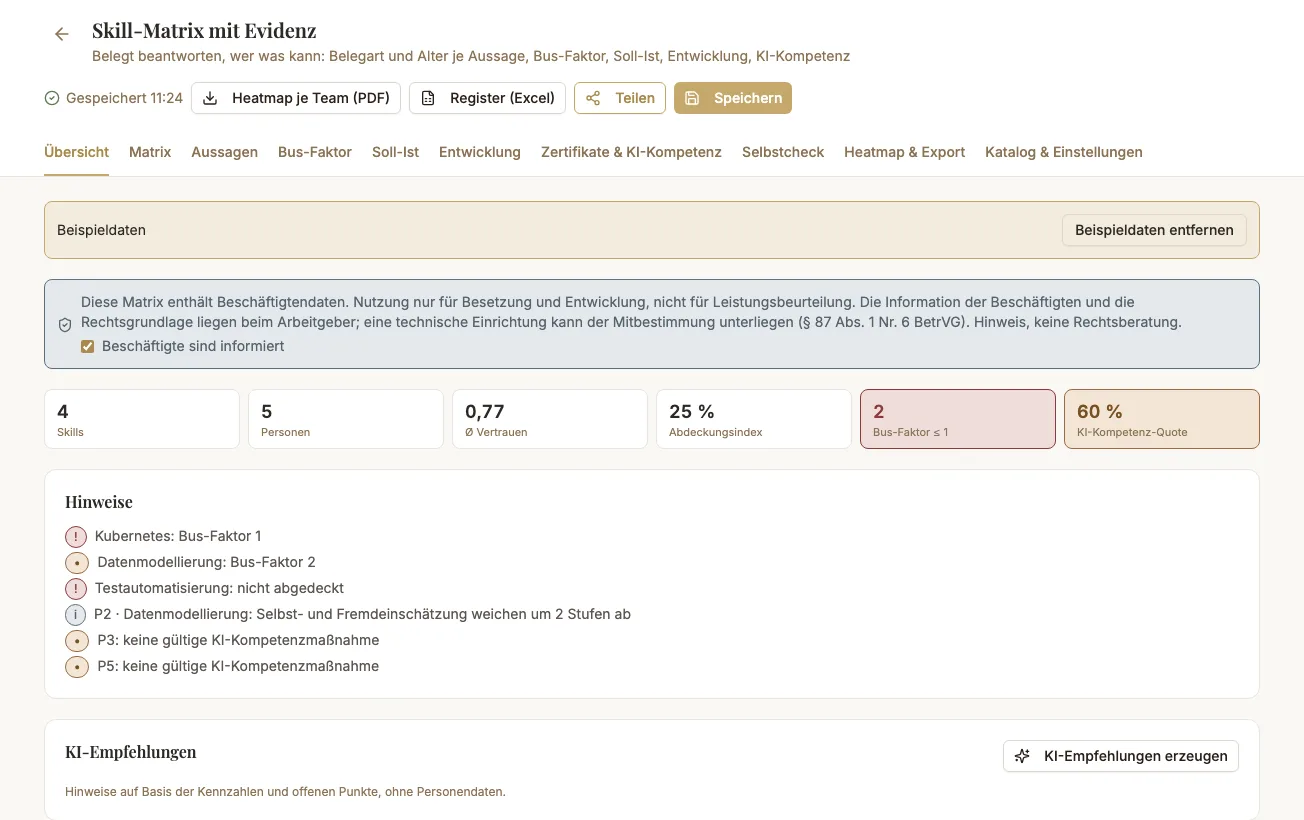
Levels 0–4 per person and skill, each with evidence type and age. This yields a reliable level per cell; if self- and peer assessments disagree, the conflict is flagged. On top: bus factor per skill with a status light, coverage index, target vs. actual per role and project demand, development plans, certificates with expiry warnings and documentation of AI literacy measures (AI Act Art. 4). There is deliberately no ranking of people.
Self-check via link
Create a round
Select skills and participants and set a deadline (at most 60 days). Each person gets their own signed link.
Self-assess
The person opens the link without an account and sees only their own skills and their own previous level – no other people. Saving a draft is possible; then the answers are submitted.
Review and apply
The matrix only changes when the owner or an admin applies the answers; they are then marked as coming from the self-check round. Renewing a link invalidates the old one.
Sales-to-delivery handover
A register of all handovers with five gates (G1–G5). Only the person with the A role in the RACI (or their deputy or the owner) can confirm a gate; each step has exactly one A. The definition of ready is weighted and has knock-out criteria. Special cases such as work before signature count working days (national and custom holidays). Key figures: time to staffing (median and mean) and the share of complete handovers. Export as minutes and portfolio PDF and as Excel.
Go-live readiness gate
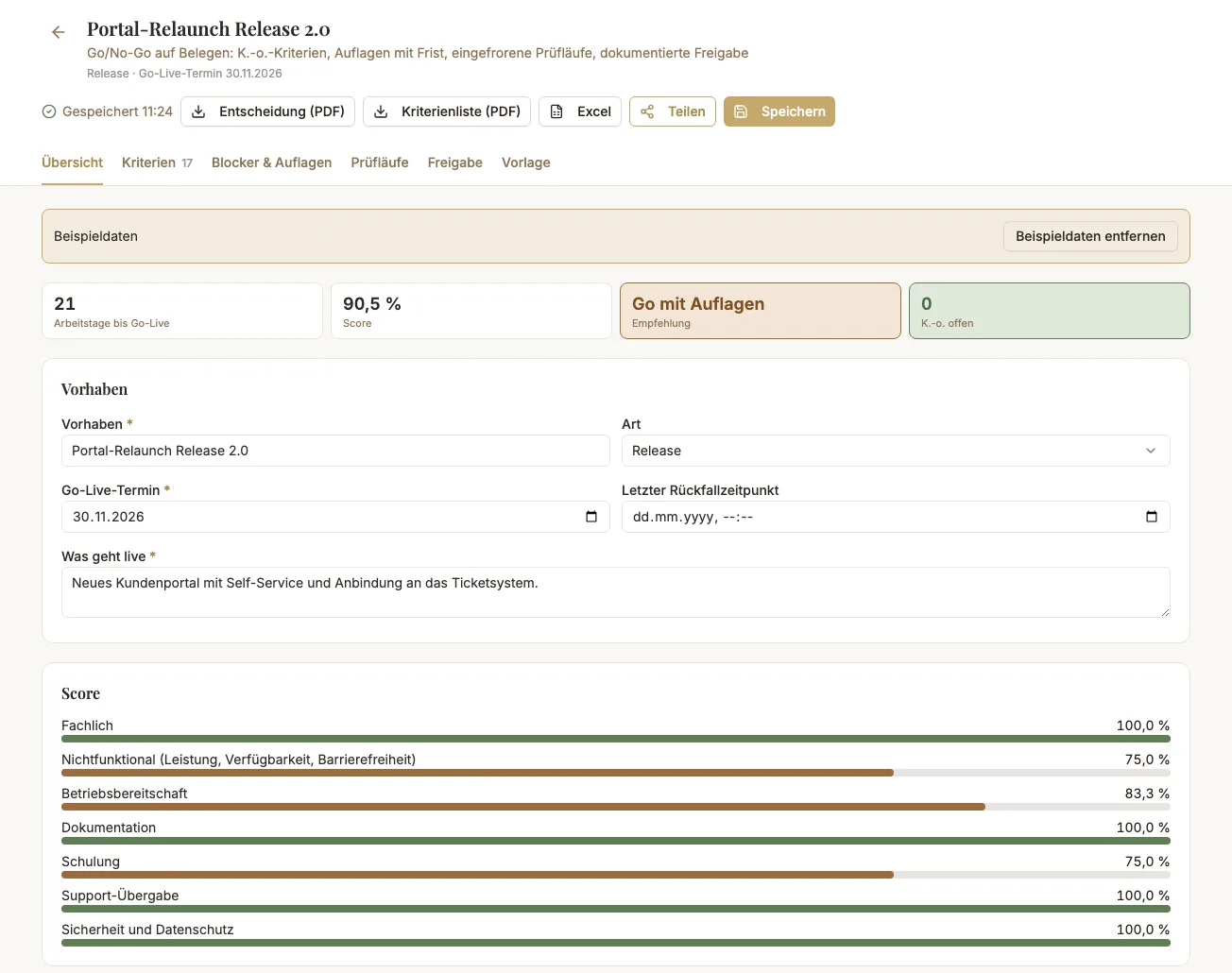
Go/no-go before acceptance or operational handover, based on evidence: four templates with criteria in seven areas and a knock-out rule, a score per area and overall, and a resulting recommendation (go, go with conditions, no-go). Conditions get a deadline; review runs can be frozen and compared. Sign-off is recorded via an account or as a captured sign-off with evidence; deviating from the recommendation requires a comment.
Decision record
Prepare decisions on one page: options with knock-out checks, weighted scoring and sensitivity (weights ±Δ) with the tipping point. A record is submitted, decided or revised; decided records are immutable and changes run as revisions. Export as a one-pager (with a warning if the content does not fit one page), an annex PDF and Excel; the decision log can be filtered.
Renewal readiness
Renew, renegotiate or terminate existing contracts on time. For each contract the latest notice date and the decision date are calculated – with the end-of-month rule and the holidays of the chosen region, never shifted later. Automatic renewals are rolled forward; four adjustable lead-time stages (default 180, 120, 90 and 60 days before the decision date) come with tasks. The renewal risk score from seven factors has adjustable weights. Views: portfolio, an 18-month deadline timeline, a contract sheet showing the calculation, and the decision log.
Root cause analysis
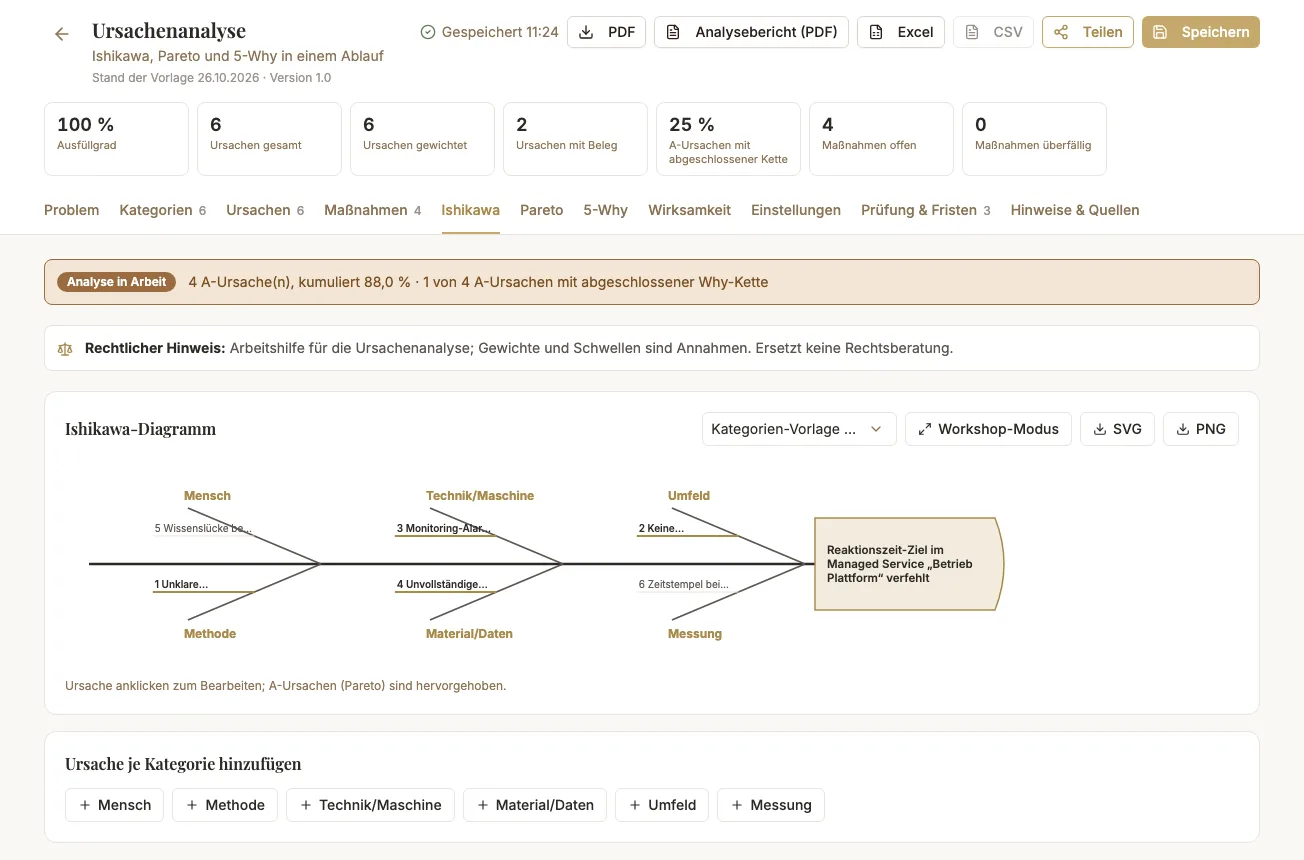
Describe the problem using 5W2H with target vs. actual, collect causes in categories (templates 6M, software delivery, operations), identify the A causes in the Pareto chart (threshold 70–90 %) and drill down with 5-Why chains; the maximum depth is adjustable and a stop rule prevents endless chains. Actions get an effectiveness check. The Ishikawa diagram is interactive (workshop mode) and can be downloaded as SVG or PNG. A notice reminds the team to look for causes in the system, not for culprits.
Meeting cadence kit
Prepare, run and follow up on regular meetings and the PMO weekly. Series (weekly, bi-weekly or nth weekday) handle public holidays as chosen: suggest a replacement date, cancel or keep. Agendas have time slots and timeboxing; open items are carried forward with their age instead of being copied, and the completion rate shows the last four meetings per series. Moderation mode brings a timer and guiding questions; decisions are recorded as provisional by default. Export: agenda and minutes as PDF, the series as an ICS file for the calendar.
Handover & deputy plan
No orphaned topics when someone leaves, is absent or changes role. The plan records topics with previous and new owner, handover dates, artefacts, access, commitments and a deputy matrix. Remaining working days, the share of handed-over topics and matrix coverage result in a status light with reasons. A standard checklist helps nothing get forgotten. Export: handover minutes and deputy matrix as PDF.