The delivery weekly cycle brings the recurring steering work of a delivery organisation onto one shared data model: define KPIs, plan capacity, decide on staffing, watch projects and produce a reliable cockpit every week. There is exactly one cycle per workspace; all views read the same data.
The views
- Overview — State of the week, team roles, load or remove sample data.
- Capacity — Attendance, absences and unrecorded load; plus a sales view with free capacity per role.
- KPI catalog — One definition per KPI with formula, base, owner and version history; conflicting definitions go to the conflict register.
- Staffing — Assignments with the states draft, decided and booked; overbookings are flagged red and confirmed individually.
- Health-Radar — Rule-based early warning per project; every signal with source and confidence.
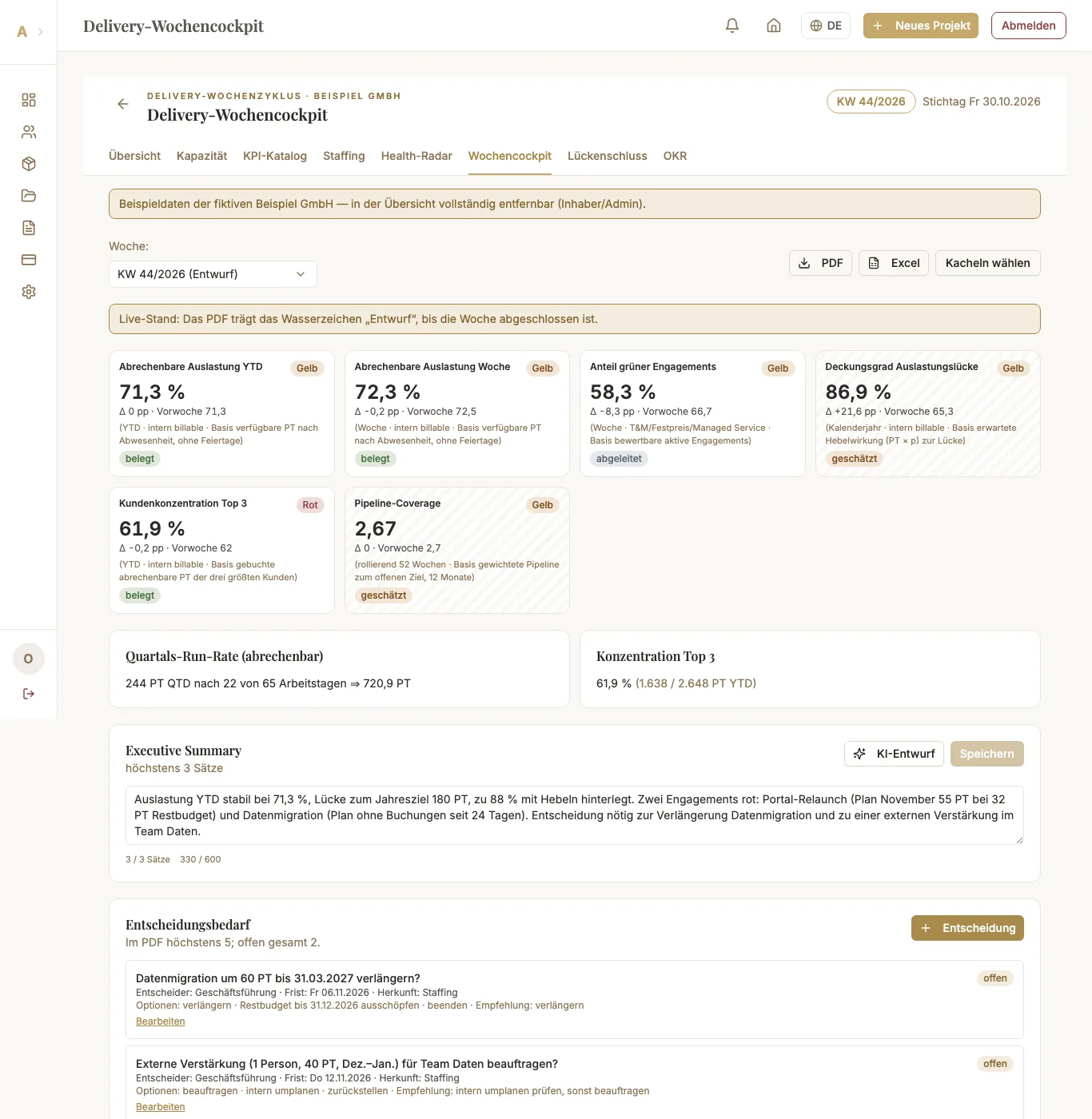
- Weekly cockpit — KPIs of the week, delta to the previous week, executive summary and decisions needed; export as a two-page PDF.
- Gap plan — Utilisation gap in person-days, levers with impact × probability and a weekly path.
- OKR — Quarterly objectives with approval and weekly check-in.
Weekly routine
1
Update the data
Maintain capacity, bookings and project signals for the current calendar week – directly or via import.
2
Review the cockpit
Check status lights, deltas and confidence per value; add the executive summary (at most three sentences) and the decisions needed.
3
Close the week
Closing freezes the state. Frozen weeks are immutable; corrections run as revisions with a mandatory reason.
Roles and costs
Visibility is enforced on the server: sales sees only free capacity per role – without names or costs. Leadership can read but does not see cost rates. Owners and admins maintain settings, rules and roles.
Tipp
Simultaneous editing is safe: if someone changes the same record in parallel, a conflict notice shows the other value – nothing is overwritten silently.