EU regulation for IT delivery: NIS2, EU DORA, CRA, AI Act and Data Act in one place
For IT leaders, CISOs and ICT providers to financial entities: who is in scope, which obligations apply, when they are due and how to report an incident – with legal references, review date and a briefing for management.
Applicability
Who is in scope?
For each regulation: the addressees named in the legal act, the number of core obligations in the cockpit and the next deadline from the calendar. Whether your organisation is actually in scope is what the applicability check in the cockpit establishes.
| Regulation | Typical addressees | Core obligations | Next deadline |
|---|---|---|---|
| NIS2Directive (EU) 2022/2555; BSIG of 02.12.2025 (BGBl. 2025 I No. 301) | Essential and important entities under Section 28 BSIG in the sectors listed in Annexes 1 and 2 BSIG. | Core obligations: 14 | no future deadline in the calendar |
| EU DORARegulation (EU) 2022/2554 | Financial entities under Art. 2 of Regulation (EU) 2022/2554; ICT third-party providers through the contractual requirements (Art. 30), critical ICT third-party providers through EU oversight (Art. 31). | Core obligations: 15 | 31 Dec 2026 · Reference date register of information 2027 |
| CRARegulation (EU) 2024/2847 | Manufacturers of products with digital elements, plus importers and distributors. | Core obligations: 6 | 11 Dec 2027 · CRA: all remaining obligations apply |
| AI ActRegulation (EU) 2024/1689 as amended by Regulation (EU) 2026/1744 | Providers and deployers of AI systems (Art. 3(3) and (4)); obligations depend on role and risk class. | Core obligations: 7 | 2 Dec 2026 · AI Act: new prohibitions (ba)/(bb); Art. 50(2) for legacy systems |
| Data ActRegulation (EU) 2023/2854 | Manufacturers of connected products, data holders and providers of data processing services (including cloud switching under Chapter VI). | Core obligations: 4 | 12 Jan 2027 · Data Act: switching charges prohibited |
Counted from the regulatory cockpit, as of 26 Oct 2026.
Deadlines
The next EU deadlines
Next up: 2 Dec 2026 – AI Act: new prohibitions (ba)/(bb); Art. 50(2) for legacy systems. Countdown in calendar days, every deadline with its legal reference.
| Date | What applies | Reference | Days |
|---|---|---|---|
Wednesday | AI Act AI Act: new prohibitions (ba)/(bb); Art. 50(2) for legacy systems | Regulation (EU) 2024/1689 Art. 113, third subparagraph, point (a), Art. 111(4) | 15 days to go |
Thursday | EU DORA Reference date register of information 2027 | Regulation (EU) 2022/2554 Art. 28(3) | 44 days to go |
Tuesday | Data Act Data Act: switching charges prohibited | Regulation (EU) 2023/2854 Art. 29(1) | 56 days to go |
Wednesday | EU DORAuncertain BaFin: register submission 2027 (regular cycle; window to be announced)Regular cycle per BaFin; the concrete 2027 window is announced at the start of the year. | Regulation (EU) 2022/2554 Art. 28(3) | 134 days to go |
Monday | AI Act AI Act: legacy GPAI models (before 2 Aug 2025) | Regulation (EU) 2024/1689 Art. 111(3) | 258 days to go |
Reporting
Reporting regimes compared
One incident can trigger several reporting duties in parallel. The table shows every stage with deadline, clock start, recipient and legal reference.
| Reporting stage | Deadline | Clock starts at | Reference |
|---|---|---|---|
NIS2NIS2 / § 32 BSIG – significant incident Recipient: joint BSI/BBK reporting point | |||
| Early warning (suspected unlawful/malicious, cross-border?) | within 24 h | Clock starts at: awareness | Section 32(1) no. 1 BSIG |
| Notification with initial assessment, severity, impact, IoCs | within 72 h | Clock starts at: awareness | Section 32(1) no. 2 BSIG |
| Intermediate report on BSI request | no fixed deadline | Clock starts at: request by the authority | Section 32(1) no. 3 BSIG |
| Final report (progress report if ongoing, final after handling) | within 1 month | Clock starts at: notification | Section 32(1) no. 4, (2) BSIG |
EU DORAEU-DORA Art. 19 – major ICT-related incident Recipient: competent authority (DE: BaFin) | |||
| Classification per Del. Reg. 2024/1772 | no fixed deadline | Clock starts at: awareness | Art. 18; Delegated Regulation (EU) 2024/1772 Art. 8 |
| Initial notification | within 4 hno later than 24 h from awareness | Clock starts at: classification as major | Delegated Regulation (EU) 2025/301 Art. 5(1)(a) |
| Intermediate report (even without status change); updated when regular activities are recovered | within 72 h | Clock starts at: initial notification | Delegated Regulation (EU) 2025/301 Art. 5(1)(b) |
| Final report after root cause analysis | within 1 month | Clock starts at: latest intermediate report | Delegated Regulation (EU) 2025/301 Art. 5(1)(c); Art. 19(4)(c) |
| Inform clients if their financial interests are affected | without undue delay | Clock starts at: awareness | Art. 19(3) |
CRACRA Art. 14 – actively exploited vulnerability / severe incident Recipient: CSIRT coordinator and ENISA via the single reporting platform | |||
| Vulnerability: early warning | within 24 h | Clock starts at: awareness | Art. 14(2)(a) |
| Vulnerability: notification | within 72 h | Clock starts at: awareness | Art. 14(2)(b) |
| Vulnerability: final report | within 14 days | Clock starts at: corrective measure available | Art. 14(2)(c) |
| Incident: early warning | within 24 h | Clock starts at: awareness | Art. 14(4)(a) |
| Incident: notification | within 72 h | Clock starts at: awareness | Art. 14(4)(b) |
| Incident: final report | within 1 month | Clock starts at: incident notification | Art. 14(4)(c) |
| Intermediate report at the request of the coordinating CSIRT | no fixed deadline | Clock starts at: request by the authority | Art. 14(6) |
| Inform affected usersuncertain | without undue delay | Clock starts at: awareness | Art. 14(8) |
AI ActAI Act Art. 73 – serious incident (high-risk providers)uncertain Recipient: market surveillance authority of the Member State where it occurred | |||
| Serious incident report | within 15 days | Clock starts at: awareness | Art. 73(2) |
| widespread infringement / critical infrastructure (Art. 3(49)(b)) | within 2 days | Clock starts at: awareness | Art. 73(3) |
| death of a person | within 10 days | Clock starts at: awareness | Art. 73(4) |
| incomplete initial report permitted | no fixed deadline | Clock starts at: awareness | Art. 73(5) |
How it works
From applicability to the briefing
Start by clarifying which regulations apply: 18 questions across 5 legal acts, each answer with its legal reference. Then the obligation matrix shows who owns what, which evidence exists and when it expires. The reporting drill walks through an incident – with the 24-hour, 72-hour and one-month clocks. The result is a briefing for management.
01
Applicability
18 questions classify each regulation; every rule names its legal reference.
02
Obligation matrix
46 core obligations with owner, status and deadline; obligations that do not apply are hidden automatically.
03
Evidence
One piece of evidence per obligation, with a date; outdated evidence stands out.
04
Reporting drill
One incident, 4 reporting regimes, one timeline: the clocks per regime from the moment of awareness.
05
Briefing
The management briefing as a PDF of at most 4 pages, plus the obligation matrix in Excel.
Registers
Registers for evidence and reporting
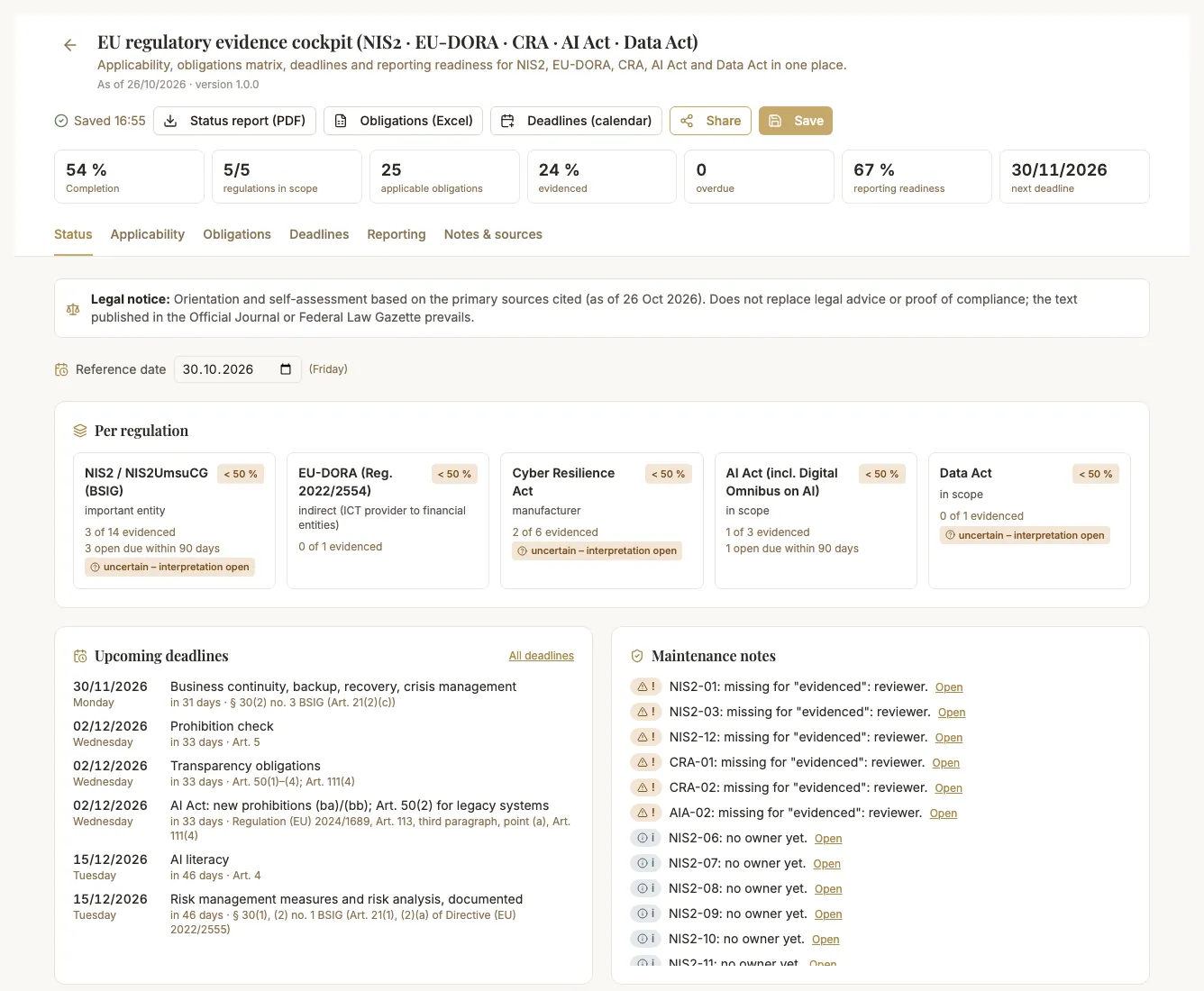
The cockpit links to registers that hold the detailed work.
EU DORA
ICT Third-Party Register (EU DORA)
Register of information under Art. 28(3) EU DORA, exported in the column codes of Implementing Regulation (EU) 2024/2956.
OpenAI Act
AI Inventory & AI Act Classification
Every AI system with role and risk class under Regulation (EU) 2024/1689 as amended by Regulation (EU) 2026/1744.
OpenFree
Vendor Assessment & SLA Tracking
Assess suppliers in a structured way – the starting point for supply chain and exit plans. Included in the Free plan.
Open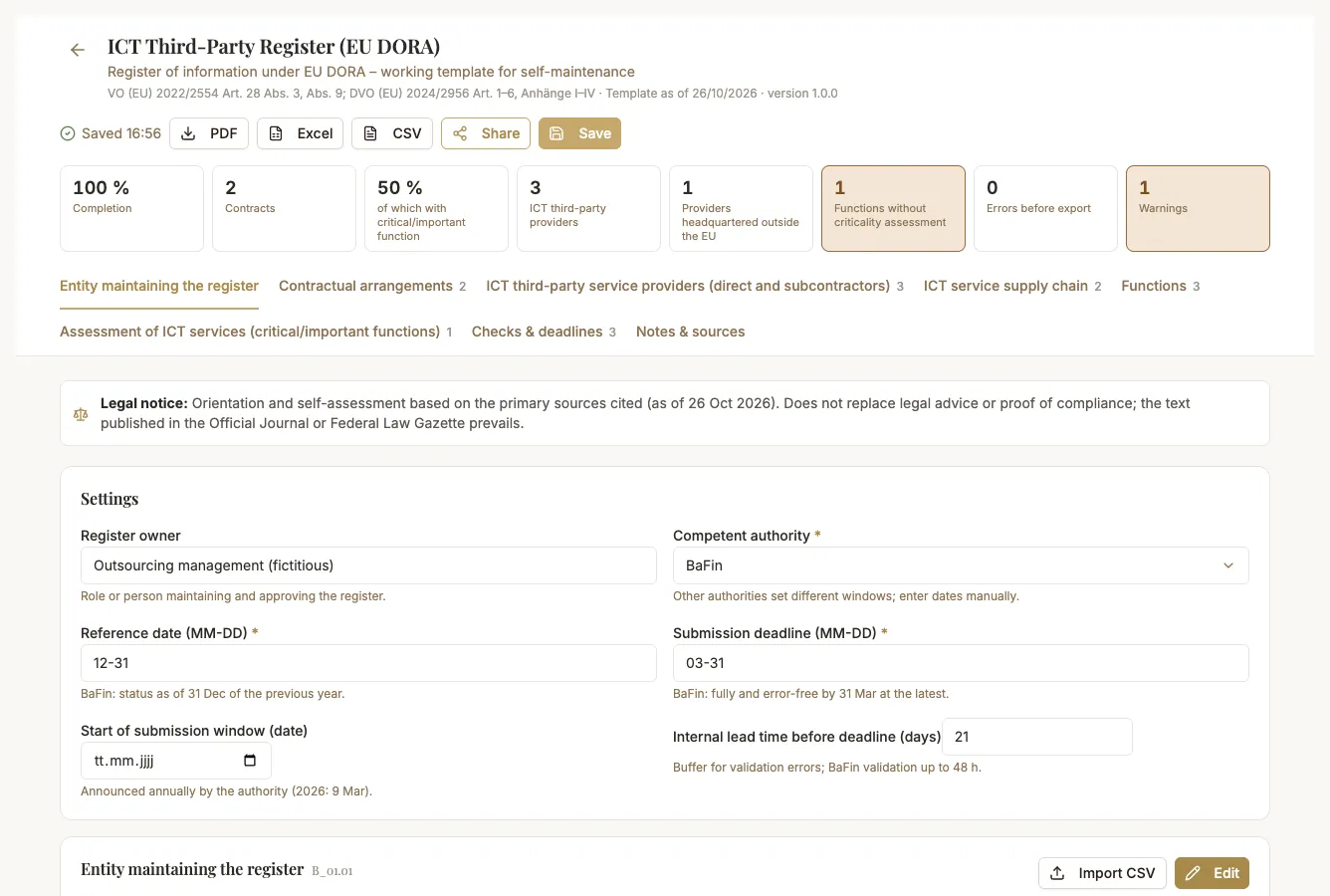
No sign-up
A first assessment in a few minutes
The free readiness checks give a non-binding first assessment, without an account.
FAQ
Frequently asked questions on EU regulation
Does NIS2 apply to us?
That depends on sector and size. The German BSIG covers essential and important entities under Section 28 BSIG in the sectors of Annexes 1 and 2. The free NIS2 check and the applicability check in the cockpit give a first assessment with legal references; they are not legal advice.
What is the difference between EU DORA and DORA metrics?
EU DORA is Regulation (EU) 2022/2554 on digital operational resilience for the financial sector. DORA metrics are software delivery metrics from the DevOps Research and Assessment programme (dora.dev). The two are unrelated, which is why Alev-B always says “EU DORA” or “DORA metrics”.
When is the reference date for the register of information?
According to BaFin, the register must reflect the position as at 31 December of the previous year; for the 2027 submission that is 31 Dec 2026. It is submitted by 31 March at the latest; BaFin announces the exact 2027 window at the start of the year, so the deadline calendar shows 31 Mar 2027 as uncertain.
What does the Digital Omnibus change?
Regulation (EU) 2026/1744 amends the AI Act. Under Art. 113 of the consolidated text, the new prohibitions in Art. 5(1), points (ba) and (bb), apply from 2 Dec 2026, the high-risk obligations for Annex III from 2 Dec 2027 and for Annex I from 2 Aug 2028.
Does this replace legal advice?
No. The cockpit, registers and calculators provide orientation and support self-assessment based on the cited primary sources (as of 26 Oct 2026). The published legal text prevails.
Can I use this without a subscription?
In part. The deadline calendar, the reporting deadline calculator and the readiness checks are free without sign-up. The regulatory cockpit, the ICT third-party register and the AI inventory are part of the Professional plan; the vendor assessment is included in the Free plan.
Further reading
Articles on deadlines and obligations
- Reporting deadlines compared: NIS2, EU DORA, CRA and AI Act in one table
- AI Act from 2 December 2026: New Prohibitions under Points (ba) and (bb) and Article 50(2) for Legacy Systems
- DORA register of information: reference date 31 Dec 2026 – what must be in the register by then
- Data Act: switching charges end on 12 Jan 2027 – what cloud contracts need now
- Regulatory Collision 2026: NIS2, DORA, CRA and the AI Act — a CIO Map
- DORA vs. NIS2 — Which EU Resilience Rule Applies to You?
- The Digital Omnibus Is Adopted: What Regulation (EU) 2026/1744 Actually Changes About the AI Act Deadlines
- Cyber Resilience Act: The 24-Hour Reporting Duty From September 2026 — an SDLC Roadmap
- Missed the NIS2 Registration Deadline: What to Do Now
- EU AI Act Article 50: What Applies to Chatbots and AI Content from 2 August 2026
- DORA Art. 30 for IT Providers: Which Contract Clauses You Must Accept — and Which Not
- DORA Enforcement 2026: From Compliance Paperwork to Real-Time Proof
- Digital Sovereignty in IT Delivery: What CIOs Really Have to Decide in 2026
Obligations, deadlines and evidence in one place
Start for free. The regulatory cockpit is part of Professional; the deadline calendar and the reporting deadline calculator stay free.
Orientation based on the cited primary sources (as of 26 Oct 2026) – not legal advice; the text published in the Official Journal or Federal Law Gazette prevails.