Since October 2026 all maturity assessments (1–5 scale) run in one shared workspace. New ones include developer experience, platform engineering, software supply chain & SBOM, SLO & experience, team topology, cloud exit & sovereignty, FinOps & AI costs and AI-assisted delivery. Existing assessments such as DevOps, cybersecurity, AI readiness, CI/CD, IaC, cloud migration and agile were updated.
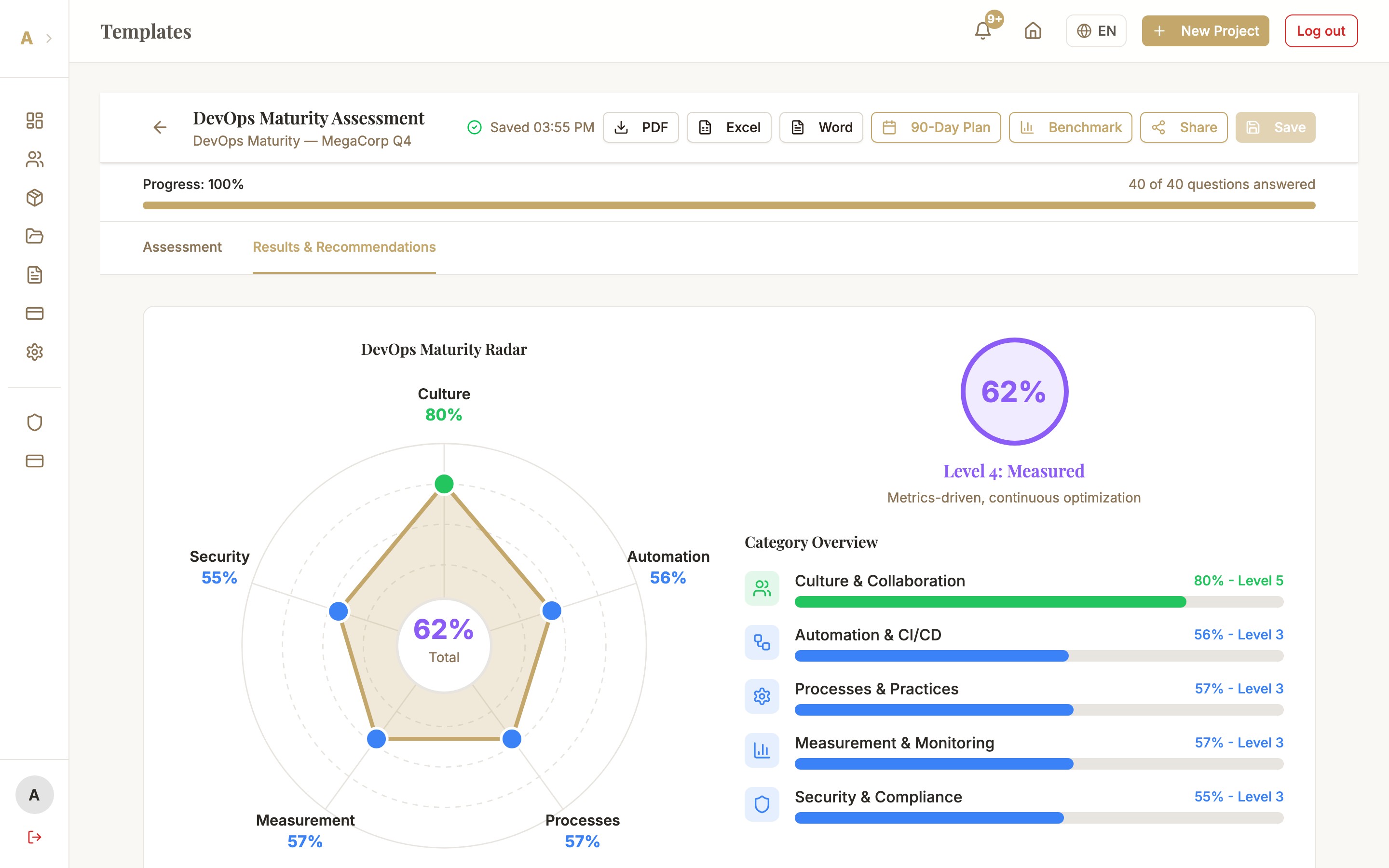
What is new
- Not applicable — Questions that do not apply to your organisation can be marked as “not applicable” and do not count towards the maturity.
- Gap list — The weakest answers sorted by risk, with a recommendation per category.
- Standards mapping — Where useful, each question shows its references, e.g. to NIST CSF 2.0 or ISO/IEC 27001:2022.
- Review date & sources — Each assessment states its review date, the framework version and the primary sources – also on the public template page.
- “Provisional” below 50 % — As long as less than half is answered, the maturity is marked as provisional.
Existing answers are kept
Questions whose content stayed the same keep their answers. New questions appear unanswered; questions whose content was revised show a “please review your answer” notice. New categories and weights can shift the maturity of existing assessments slightly.
DORA metrics dashboard
The dashboard follows the current DORA model with five metrics: change lead time, deployment frequency and failed deployment recovery time (throughput) plus change fail rate and deployment rework rate (instability). Several measurement points form a trend; the mapping to the closest of the seven DORA 2025 team archetypes is a disclosed heuristic.
Collaborate without overwriting
If two people work on the same assessment at the same time, Alev-B detects the conflict on save and offers to load the latest state – instead of silently overwriting.